In mid-May, I joined fellow ecumenical officers from across the Member Churches of Churches Together in England (CTE) for the bi-annual Enabling Group gathering at High Leigh Conference Centre. Over 24 hours, we shared worship, learning, conversation and fellowship, creating space to reflect together on some of the opportunities and challenges facing the church today.
The event included rich times of worship led by colleagues from the Church of England and Methodist traditions. These moments reminded us that, despite our different traditions and expressions of faith, we are united in Christ and in our commitment to working together. The closing devotions were led by Bishop Hovakim, from the Armenian Orthodox Church, who is the current CTE President for the Orthodox Churches. Together with colleagues from the other Orthodox churches present, Bishop Hovakim led the meeting in a moving short service of Orthodox Prayer.
A significant focus of our gathering was the challenge of Christian Nationalism. Through a series of thought-provoking sessions, we were invited to explore the theological, social and pastoral implications of a subject that is both complex and increasingly relevant.
CTE’s Principal Officer for Pentecostal, Charismatic and Multi-cultural Relations, Minister Shermara Hoyte, opened the conversation by posing deep theological questions around identity, belonging and the relationship between faith and power. I found myself leaving with as many questions as answers—a sign, perhaps, of a session that truly challenges us to think more deeply.
We also heard from UK Director for the Evangelical Alliance, Peter Lynas, whose perspective from Northern Ireland reminded us that nationalism means different things in different contexts. One of the strongest messages I took away from his session was the importance of remembering where our primary identity lies—not in political affiliations, national identities or ideological positions, but in God.
Director of the Centre for the Study of Bible and Violence, Bristol Baptist College, Rev Dr Helen Paynter helped us engage with the topic from an everyday perspective, exploring practical ways to recognise and reduce extremism and offered thoughtful ways of fostering understanding, reducing polarisation and pursuing unity even when we disagree. Her insights felt particularly relevant in a time when public discourse often seems driven by division rather than dialogue.
Together, these contributions sparked rich discussion and raised important questions that many of us will take back to our own traditions and organisations. They are conversations that need to extend beyond church leaders and into our congregations, helping Christians engage thoughtfully with the challenges of our time.
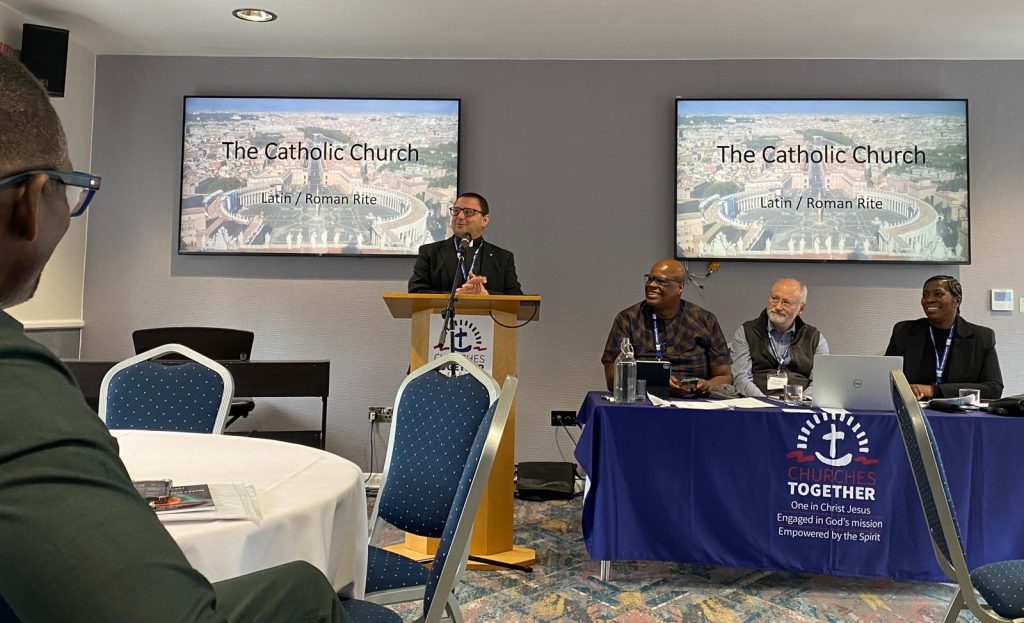
We also enjoyed a fascinating whistle-stop tour of two Member Churches in the ‘From Our Tradition’ slot. The National Ecumenical Officer of the Catholic Bishops’ Conference of England and Wales, Father Marc Homsey, addressed many of the questions that Christians from other denominations often ask about Catholicism with humour, warmth and great clarity. It was a wonderful reminder that taking time to understand one another’s traditions can break down assumptions and build stronger relationships.
Pastor Michael Boatey from the International Ministerial Council of Great Britain shared the history, current projects and challenges of his church, which is a member of CTE’s Pentecostal and Charismatic Forum.
We were privileged to hear from Archbishop Nikitas, who spoke about his experience as President of the Conference of European Churches and the updated Charta Oecumenica. Charta Oecumenica provides guidelines for practical ecumenical engagement, encouraging churches to work together on issues of justice, peace, and care for creation, and to strengthen fellowship across denominational boundaries.
The meeting paid tribute to Archbishop Fidelia Onyuku-Opukiri of the Council of African and Caribbean Churches UK. Archbishop Fidelia is one of the pioneers of Churches Together in England and has been a member of Enabling Group for over thirty-five years. CTE General Secretary, Bishop Mike Royal, thanked her for her dedication to the ecumenical journey.
During a time of news sharing from the Member Churches and representatives of ecumenism in the regions, Warren Evans of Sports Chaplaincy made a passionate case for recognising sport as an important space for mission and discipleship; encouraging us not to dismiss sporting communities simply because they may not engage with the church in a traditional way.
Alongside the formal programme, there was plenty of time for conversation, laughter and friendship. As always, some of the most valuable moments happened over meals and coffee breaks.
I left High Leigh encouraged by the openness, honesty and shared commitment to Christian unity that characterised our time together. The Enabling Group continues to be a valuable space where we can learn from one another, wrestle with important questions and deepen the relationships that help sustain our ecumenical work.
A note on Thursdays in Black
You may notice that most of the people in the photo at the top of this page are wearing black clothes. That is because at this Enabling Group, we joined #ThursdaysInBlack, a global movement against gender-based violence.
Thursdays in Black is an inspiring ecumenical initiative of the World Council of Churches, which we know many of our Member Churches and partners are already supporting.