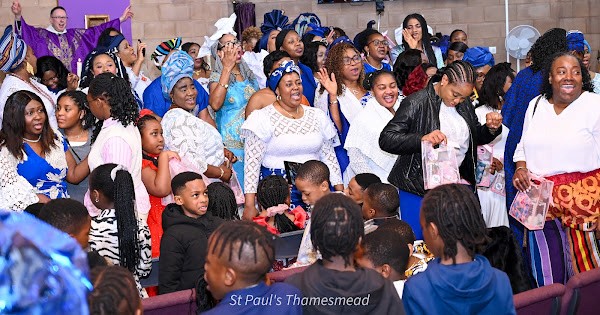
On a bright morning in early spring, we (CTE staff members Doral Hayes and Ben Aldous) jumped off the train at Abbey Wood on the Elizabeth line to be picked up by the Rev Patrick Egglestone for a whistle stop tour of Thamesmead to hear the story of the area and the church. Thamesmead, with a population of about 50,000 people, was founded as a new housing area in the 1960s and 1970s with the social housing all built by the Greater London Council (GLC). Three churches (St Paul’s (1978), Church of the Cross (1973) (both LEPs) and William Temple (1966) were all founded during that time. As the area diversified racially late 80s and 90s many Nigerian and Ghanaian families moved in, and today St Paul’s congregation is about 80% Nigerian, 15% Ghanaian with a handful of other West Africans. Patrick has led the congregation for the last 12 years and says that whilst the tradition at St Paul’s is broadly anglo-catholic, over the past decade or so the worship has become more shaped by the Nigerian congregants and their families.
Patrick says that in many ways nothing in his formation for ministry prepared him for this ministry context but finds the Anglican liturgy an anchor of the familiar which leaves room for improvisation and trying new things.
The church is full of families, and the building also provides a much-used community space offering children’s activities and learning opportunities for the community. While we were visiting Patrick was approached by a new mother to arrange a baptism for a young baby. Whilst acknowledging the ups and downs of church life and ministry, it was clear to see the joy that Patrick finds in his diverse and dynamic ministry in Thamesmead.
One fascinating element of St Paul’s church building is that is has two sanctuaries. One for Anglican, URC and Methodist worship and directly opposite, with only a corridor and glass windows between them, a Roman Catholic worship space. This was the original design and purpose from the beginning. Patrick told us that both the communities have a similar ethnic make-up and are growing. The physical proximity of the two sanctuaries means that ecumenical co-operation is not just desirable but essential. Even an issue as simple as service times need to be negotiated as well as other aspects of practical ministry. Good ecumenical relationships are required across the parish, and these also extend to the many churches outside the LEP as well.
Question: Is there a link between being ecumenical and intercultural in growing churches?
Through access to statistics for mission from the Church of England we can see that the LEPs that are growing tend to be made up of diaspora communities or are working towards being intentionally intercultural. One of the questions we are asking ourselves at CTE is, ‘do the dynamics of being an ecumenical church, which embodies variety and the need to embrace and love across difference, make it more likely that a church will become, or have the potential to become intercultural?’ Does the ecumenical welcome that naturally exists within LEPs mean that a more radical welcome to others who are different in other ways is more likely?
What is your or your church’s experience? If you have any stories from your area that would help us consider these questions further please do get in touch. Email CTE Principal Officer for Mission and Evangelism, Rev Dr Ben Aldous.
Photos courtesy of St Paul’s Thamesmead.