On 31 March 2026, a significant moment took place in London as Pentecostal and Catholic theologians, church leaders, and national ecumenical officers gathered for the first official Catholic Pentecostal dialogue in England. Hosted at the Catholic Bishops’ Conference of England and Wales in Eccleston Square, the meeting marked the beginning of a new phase of relationship building between two traditions that share much, yet have rarely met in this way at a national level.
The day began simply with tea, coffee, and conversation, but it quickly became clear that this was no ordinary meeting. There was a genuine openness in the room, with participants bringing both theological depth and a willingness to listen and learn from one another.
The representatives of the Pentecostal and Charismatic Forum (from Churches Together in England) were:
- Professor Wolfgang Vondey, Professor of Christian Theology and Pentecostal Studies and Director of the Centre for Pentecostal and Charismatic Studies at the University of Birmingham.
- Dr Caleb Nyanni, President of the European Pentecostal Theological Association and Academic Dean of Birmingham Christian College.
- Dr Carol Tomlin, Erasmus lecturer in Groningen and visiting tutor at The Queen’s Foundation, Birmingham, visiting fellow at the University of Leeds and senior research fellow for the William Temple Foundation.
- Rev Dr Akpo Onduku, National Ecumenical Officer for the Redeemed Church of God. Rev David Whyte, National Superintendent of the Wesleyan Holiness Church UK.
- Min Shermara Hoyte, Churches Together in England Principal Officer for Pentecostal, Charismatic and Multicultural Relations.
Those in the group who were not present included Archbishop Doye Agama, Founder of the Apostolic Pastoral Congress and former President and presiding prelate, and Richard Bradbury, National Ecumenical Officer for Ground Level.
They were joined by Catholic representatives including:
- Abbot Hugh Allan, O.Praem, Director of Mission at the Catholic Bishops’ Conference of England and Wales.
- Fr Marc Homesy, a priest of the Diocese of Leeds, and the National Ecumenical Officer for the Catholic Bishops’ Conference of England and Wales.
- Prof Dr Jacob Phillips, Professor of Systematic Theology at St Mary’s University, Twickenham, London.
- Dr John Stayne, Yves Congar Postdoctoral Fellow at the Pontifical University of Saint Thomas Aquinas, Rome (also known as the Angelicum).
- Prof Paul D. Murray, Professor of Systematic Theology at Durham University.
- Elliot Vanstone, Senior Mission Adviser at the Catholic Bishops’ Conference of England and Wales
Those in the group who were not present included Fr Peter Wygnanski, a priest of the Diocese of East Anglia. The meeting was supported by Kinga Kosterska.
Opening in prayer, Abbot Hugh Allan set the tone by framing the gathering as a space for encounter rather than debate. That spirit carried through the introductions, where each person shared their context and experience, offering a glimpse into the diversity of the church in England today.
A key moment in the morning was the historical overview of Catholic Pentecostal dialogue, which set this meeting within a wider global story of ecumenical engagement. While this was a first in the United Kingdom, it was clear that it is building on years of dialogue, learning, and relationships across the world.
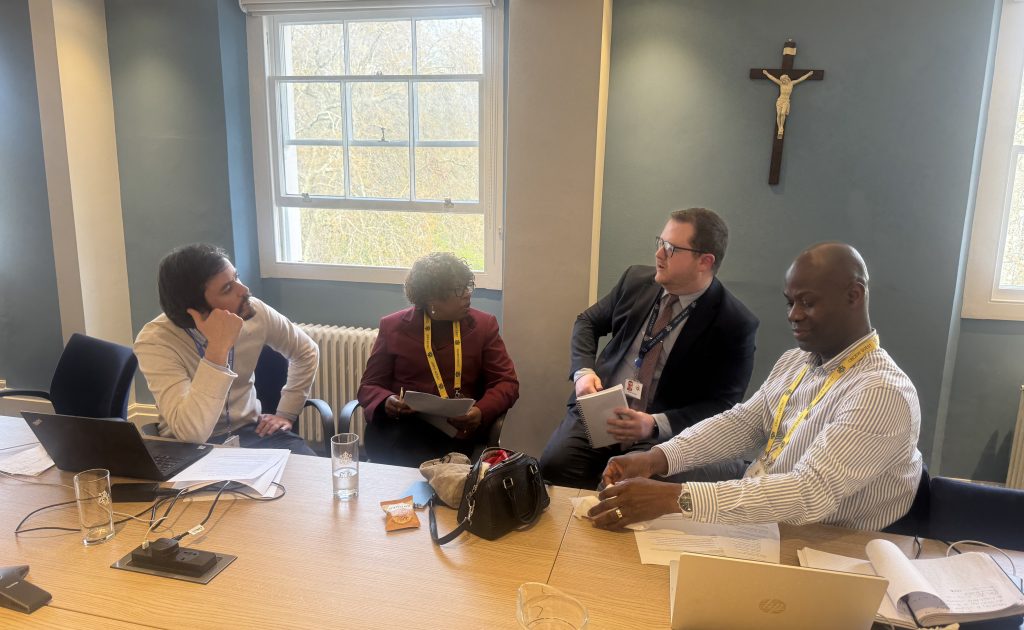
The small group discussions that followed allowed for honest and reflective conversation. Participants spoke openly about both the opportunities and the sensitivities involved and began to shape a shared understanding of what a meaningful dialogue could look like.
In the afternoon, the focus shifted to how the group might work together going forward. A time of Scriptural Reasoning created space to engage Scripture together across traditions, modelling a way of listening that was both attentive and generous. It was a reminder that unity is not about removing difference, but about learning how to hold it well.
Further input explored the proposed structure of the dialogue over the next five years, alongside reflections from the Anglican Pentecostal dialogue, offering helpful lessons as this new journey begins.
As the day came to a close, there was a clear sense that something important had started. Conversations had moved beyond introduction to relationship, and there was a shared commitment to continue meeting, learning, and discerning together.
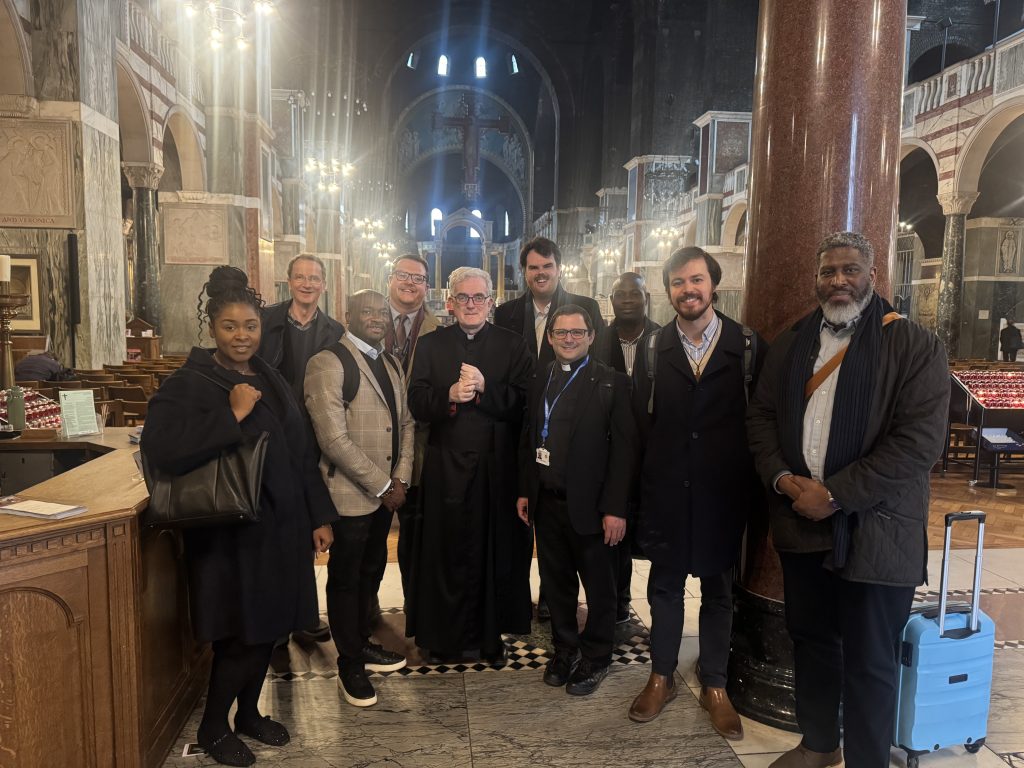
An optional visit to Westminster Cathedral provided a fitting end to the day, allowing for continued conversation in a more informal setting. The visit enabled both parties to immerse themselves in Catholic teaching, theology, and doctrine. Seeing the Cathedral alive with worshippers offered an opportunity not only to experience the place of worship itself, but also to witness ordinary Catholics engaging with their faith in everyday life. Its stunning architecture and beautiful design took the contributors on a journey through Catholicism. We were also delighted to be given the tour by James Holland, Ecumenical Coordinator in the Archdiocese of Westminster.
This first gathering represents an important step for ecumenical bilateral dialogues in England. At a time when division can often feel dominant, it offers a quieter but powerful witness that unity is possible and that when we take the time to listen well to one another, something deeper begins to grow.
Discovering deeper communion
Dr John Stayne, one of the Catholic representatives and an alumnus of The Bill Snelson Young Ecumenists Fund, wrote this report for the Angelicum (the Pontifical University of St. Thomas Aquinas in Rome) where he is a Postdoctoral Fellow.
On 31 March, Catholic and Pentecostal participants gathered at Eccleston Square for the inaugural meeting of the national Catholic–Pentecostal official dialogue. It was a moving experience. Sponsored by the Catholic Bishops’ Conference of England and Wales and the Pentecostal and Charismatic Forum, the dialogue gathered theologians and church leaders to meet, listen, and pray; while also discerning the concrete shape the dialogue is to take over the coming years.
Our meeting was both building on a rich prior history and coming at a time of increasing mutual appreciation. Pentecostals and Catholics have had a long and unique relationship – especially thanks to the person of David Du Plessis, the Second Vatican Council, the Catholic Charismatic Renewal, and the long-running official international Catholic–Pentecostal dialogue. Despite this rich history, however, we seem to be entering a new stage – seen in the presence of a Pentecostal observer at the Synod on Synodality, the focus of the study group on Christian unity of that Synod specially emphasizing the need to better understand Pentecostal and charismatic churches, and in several new national dialogues. The participants, as became clear across the day through the responses and various times of discussion, all had great anticipation for the future. As one later commented: “There was a genuine openness in the room, with participants bringing both theological depth and a willingness to listen and learn from one another”.
As the dialogue moves forward, my hope is that the positive relationships that were established at this first meeting can continue to be deepened. That we can better understand each other and discover deeper communion. That we can overcome obstacles and so further collaborate. Being filled with the Holy Spirit, as William J. Seymour once noted, “brings us all into one common family”. And as Pope Leo XIV recently commented, it is the Holy Spirit “who inspires us and impels us towards full unity and the common witness to the Gospel”. It was the Spirit poured out on Pentecost who allowed the division of Babel to be overcome, making the apostles be understood in many different tongues. As we walk together into the future, my prayer, then, is that the Spirit will continue to be poured out, allowing the divisions within Christianity to be further overcome.
Find out more about national and international ecumenical dialogues.