On 26 November 2025, representatives from different church traditions and from CTE Charities and Networks in Association (CNAs) who produce Bible resources gathered to explore how we could work together to further discipleship and increase Bible confidence in Christians across England.
I was there representing my organisation, Roots for Churches, which is an ecumenical partnership that produces lectionary-based worship resources for adults, young people and children. Fellow scripture resource providers and CTE CNAs BRF Ministries, Bible Society, Faith in Later Life, GOLD Project and Lifewords were also in attendance.
To start the day, we heard from the Senior Data Insight Lead for the Bible Society, Dr Yinxuan Huang, about his research into Bible confidence. Dr Yinxaun’s research identified three dimensions of Bible confidence among churchgoing Christians:
- Head – am I confident in my intellectual understanding of the Bible?
- Heart – is the Bible personally meaningful to my spiritual life?
- Hands – is my daily life guided and transformed by the Bible?
The research (amongst 3000 believers from a broad range of churches) showed that the confidence of different age, social and ethnic groups varied between the dimensions. Overall though, Bible confidence is stronger among Global majority backgrounds. And those who have converted to the Christian faith have become more Bible confident than those who have been raised in Christian homes/the church.
Download Dr Yinxaun’s presentation: Bible Confidence: Its Nature and Implication for Discipleship.
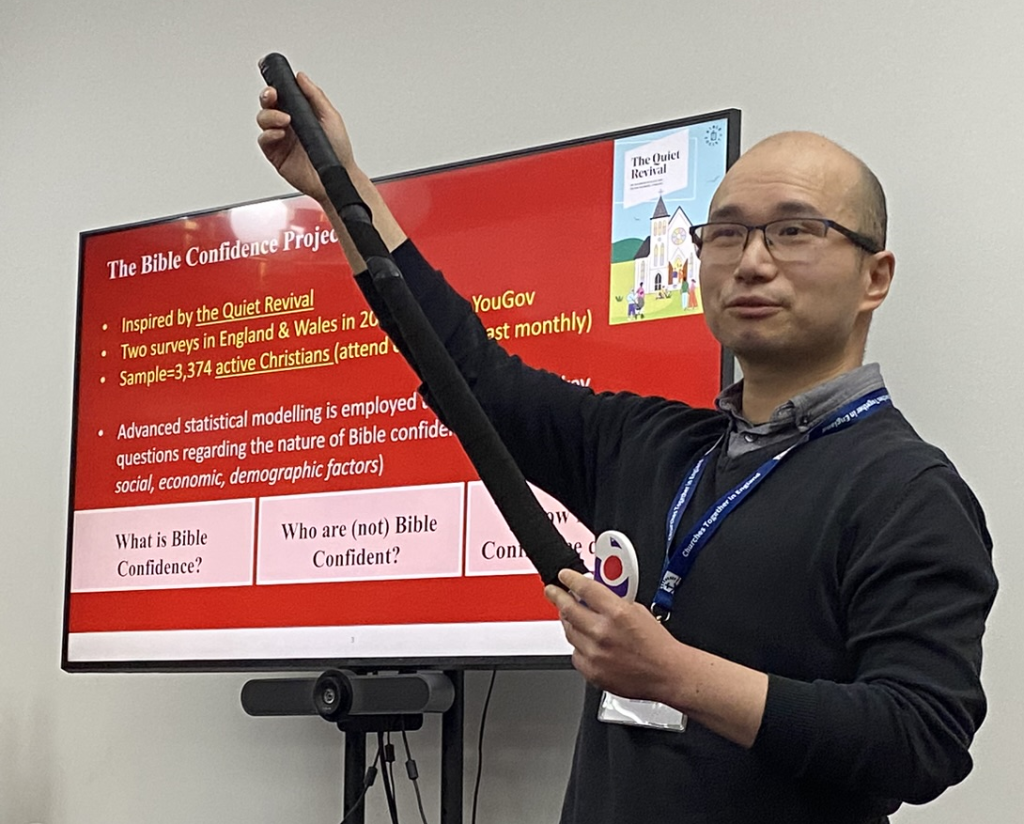
With a firmer grasp of the strengths and gaps in Bible confidence, we then heard representatives from the Catholic Bishops’ Conference of England and Wales, the Church of England, the Council of Lutheran Churches and the Ecumenical Patriarchate share how their churches ‘do’ discipleship. There were obvious differences in terminology, for example, alpha, everyday faith, faith formation, catechesis, but all the churches and organisations agreed that reading and unpacking scripture is an essential part of discipleship.
The discussion was really wide-ranging and stimulating. We shared thoughts about the challenge of online influencers that could be pointing young people towards Christianity. How do we disciple people coming to church with expectations shaped by culture war content or other sound-bite theology. How do we offer nuanced, faithful content in an attention economy, when the algorithms want polarisation? We wondered if evangelism courses or catechesis could have an ’unhelpful end point’ in that the resources or courses move participants towards completion, when discipleship is a whole life journey.
For the final part of the day, the delegates split into three breakout groups to discuss: how we encourage discipleship in the workplace, how we grapple with the challenges of discipleship in the digital/online/AI sphere, and how we develop discipleship resources for those in later life.
We all agreed that it had been useful to spend time together. Amongst the group there was a definite appetite to gather again to continue to partner, share learnings, best practice, and maybe even develop shared resources.
If you’d like to find out more about this group, please contact the CTE Principal Officer for Mission and Evangelism, Rev Dr Ben Aldous.