Few subjects currently require more careful Christian discernment than the relationship between faith, national identity and belonging. Questions about immigration, cultural diversity and what holds a country together are increasingly prominent in public life. Christians are part of those conversations, and faithful Christians can reach different prudential political judgements.
That is why Churches Together in England’s Kingdom over Nation resource is both timely and important. Developed in response to concerns raised across CTE’s member churches, it invites Christians from different traditions into a shared process of biblical, theological and pastoral reflection on Christian nationalism.
The resource includes Bible studies, video material and contributions from across the Christian traditions. Its purpose is not to prescribe a particular political position. Rather, it helps churches create the conditions for honest, informed conversation about nation, identity and belonging in the light of Christian faith. At its heart is a question deeper than party politics: what forms us as Christians, and where does our deepest allegiance lie?
This is not an abstract question. Events this summer in Norfolk and elsewhere in the country have shown how quickly questions about immigration, identity and belonging can become immediate and divisive. That does not mean that those involved in such demonstrations are all Christian nationalists, nor should people expressing concerns about immigration simply be given that label. Christian nationalism is something more specific but the issues it seeks to focus on tend to be the same.
The problem with Christian nationalism arises when Christian identity and national identity become so closely bound together that Christianity begins to sanction a particular political understanding of the nation and who belongs within it. Questions about immigration, cultural change and national identity can then become entangled with claims about Christianity itself. The danger is that Christianity is made to serve a political project rather than bringing that project under the judgement of Christian faith.
This distinction really matters. Christians can (and do) disagree about immigration policy, borders, integration and the responsibilities of government without their disagreements being evidence of Christian nationalism. The more fundamental Christian question is whether our political convictions remain subject to the demands of the Gospel, including the dignity of every person and our responsibility for the common good.
This is also why Kingdom over Nation is ecumenically significant. Churches need places in which difficult questions can be discussed honestly, without caricature and without allowing political disagreement to fracture the body of Christ. Christian unity does not require political uniformity. It does, however, require us to recognise an allegiance to Christ deeper than our political differences.
Explore Churches Together in England’s Kingdom over Nation resource
Loving What Is Ours: Patriotism and the Desire for Human Flourishing
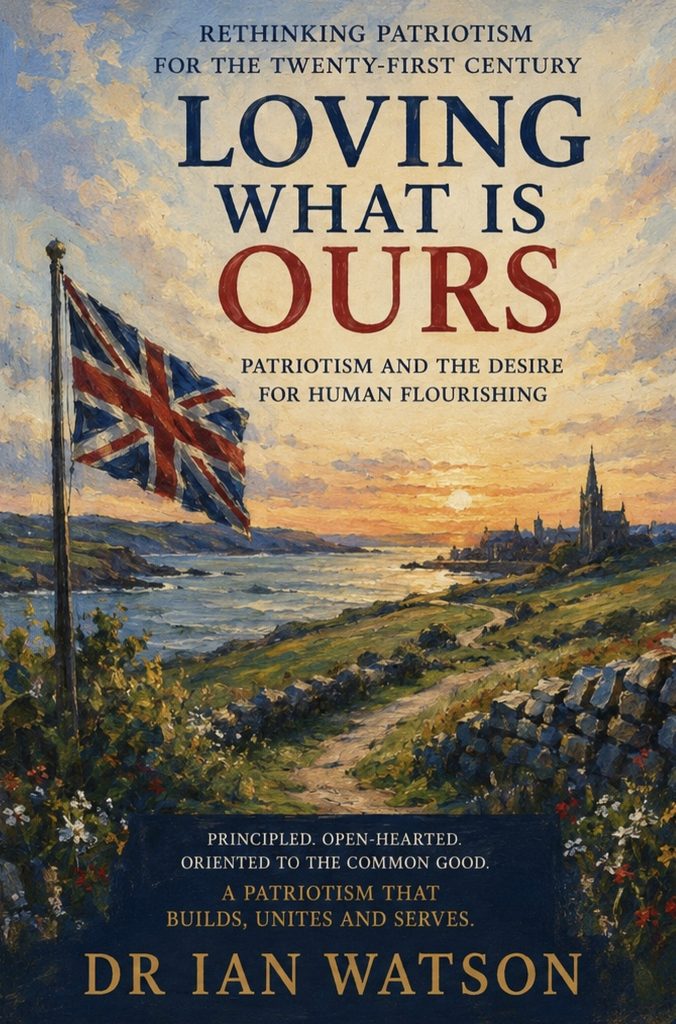
If you would like to read more on this topic, I have just published a new book called Loving What Is Ours: Patriotism and the Desire for Human Flourishing. Growing out of my doctoral research in moral philosophy, it asks whether love of country can be morally justified. Its final three chapters bring that philosophical argument into conversation with Catholic Social Teaching, exploring rightly ordered love, Christian nationalism, human dignity and the common good. Although written from my own Catholic perspective, the discussion is intended for Christians of all traditions, people of other faiths and those of none.