On Saturday 19 September, my young grandchildren and I were among more than 600 people who joined a Quaker-led Silent Walking Vigil for Peace. The date and place were both especially appropriate: just before the United Nations International Day of Peace, and in central London, along Whitehall and through Trafalgar Square.
Our train was late, and therefore so were we, but we recognised the silent Meeting for Worship as we walked through the Victoria Embankment Gardens, and we sat down at the edge to join the silence. Many people, like us, had taken up the suggestion to dress in white, while others wore the distinctive blue ‘Quakers for Peace’ t-shirts.
At the end of the meeting, we all gathered behind the simple ‘Quakers for Peace’ banner, fortified by Quaker Vegan Witness flapjack, and began to walk. I had not realised until then, looking up at the looming buildings and statues above us, how much of the capital’s centre is dominated by the images and systems of war. Pedestrians, tourists and shoppers, watched us with, mostly benevolent, interest, many taking the card of explanation and welcome. “Silent walking vigil for peace,” it read, “Showing solidarity and care for everyone impacted by violence, conflict and war.” Five dimensions or lenses of peace were identified: in our hearts; in communities; among nations; in the world; and for the planet. “If you share our hope for peace,” it invited, “walk with us quietly for as long as you can.” And many did, even as we reached Trafalgar Square and heard the angry hooting of car horns as our stewards, gentle but determined, guided us expertly through the noise and tension.
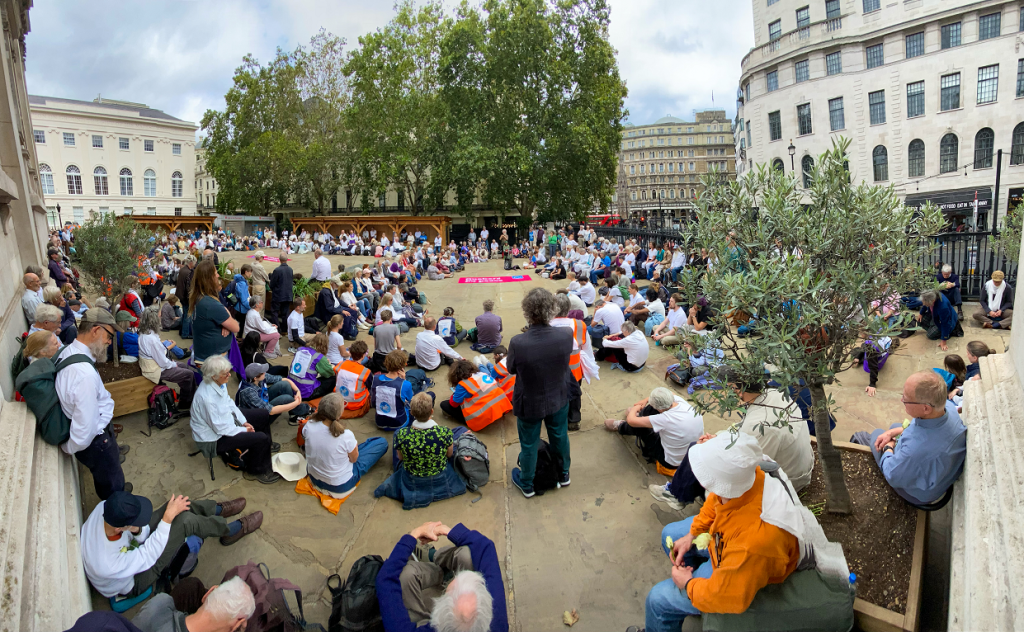
We ended our walk with a second Meeting for Worship, in the courtyard of St Martin-in-the-Fields. I was delighted to see Judith Baker, my predecessor as Quaker Ecumenical and Interfaith Officer and Tim Gee, General Secretary of the Friends World Committee for Consultation, with some of the many people from other churches and faiths who had joined us for the walk. They included the General Secretary of Churches Together in England, Bishop Mike Royal, Joel Zantingh of the World Evangelical Alliance’s Peace and Reconciliation Network, Anupama Hial of the Lutheran World Federation and Andrew Suderman of the Mennonite World Conference.
It was a moving reminder that the Quaker concern for peace, dating from our seventeenth century roots, and realised in many acts of courage, compassion and careful, quiet diplomacy, is shared by many Christians and others. Now, as the nations arm yet again, with new and deadly technologies, waging wars and threatening more, the still small voice of the peacemaker is needed more than ever. Sometimes, as on that day, the silence speaks louder than the tumult.
Read more reflections on the vigil gathered by Quakers for Peace.
All photos credit: Michael Preston for Quakers in Britain