I am deeply grateful to Churches Together in England (CTE) and The Bill Snelson Fund for supporting my participation in the Jubilee of Prisoners in Rome in December 2025. I had initially planned to attend the Jubilee of Youth; however, visa delays prevented my participation. As a result, I shifted my focus to the Jubilee of Prisoners, which offered an equally rich ecumenical experience and provided unexpected opportunities for reflection on justice, mercy and Christian unity.
The Jubilee of Prisoners, the final major celebration of this year-long Catholic celebration, brought together chaplains, volunteers, pastoral workers and those affected by imprisonment, holding in view both people inside custodial institutions and those outside who carry the wider impact of incarceration within families and communities. This framing immediately broadened my understanding of prison ministry and highlighted the Church’s call to accompaniment rather than exclusion.
I was one of around 6000 pilgrims from more than 90 countries who gathered in Rome for this event. My visit started at the Fraterna Domus – a simple guest house with meeting rooms. It provided an intimate and reflective starting point. The simplicity of the space created room for prayer, testimony and honest dialogue. Listening to those involved in prison chaplaincy and volunteer ministry was particularly formative. Their emphasis on faithful accompaniment, walking alongside rather than seeking to fix, reshaped my understanding. The ecumenical service of prison chaplains and volunteers is lived through presence, humility and long-term commitment.
The next part of my Jubilee experience was the pilgrimage to the Holy Door. The Holy Door at the Vatican (St. Peter’s Basilica) is a sacred entrance that opens only during Jubilee Years, symbolising a spiritual passage from sin to grace. It was opened by the late Pope Francis at the end of 2024 and closed by Pope Leo XIV at Epiphany this year. For the walk, we were provided with translated prayer booklets, enabling our full participation in the prayers and readings as we pilgrimaged. I was able to reflect deeply on the themes of Jubilee, imprisonment, mercy and renewal.
Through the Holy Door is St Peter’s Basilica. It was my first visit and the Altar of the Chair (Cathedra Petri) by Bernini was particularly impactful. Seeing the Baldachin (the grand canopy, pictured behind me in the photo above) drew my attention to the altar as a place where authority is exercised through service and sacrifice. The Holy Father presided over the Jubilee Mass, the profound spiritual centre of this ecumenical experience. The celebration of the Eucharist, alongside animated congregational singing and Scripture readings proclaimed in multiple languages including English, Italian and Chinese, offered a powerful expression of unity across cultures and traditions. Although much of the spoken liturgy was delivered in Italian, meaning was communicated richly through music, gesture and sacrament. The exchange of peace through handshakes and embraces offered tangible expressions of reconciliation and shared belonging.
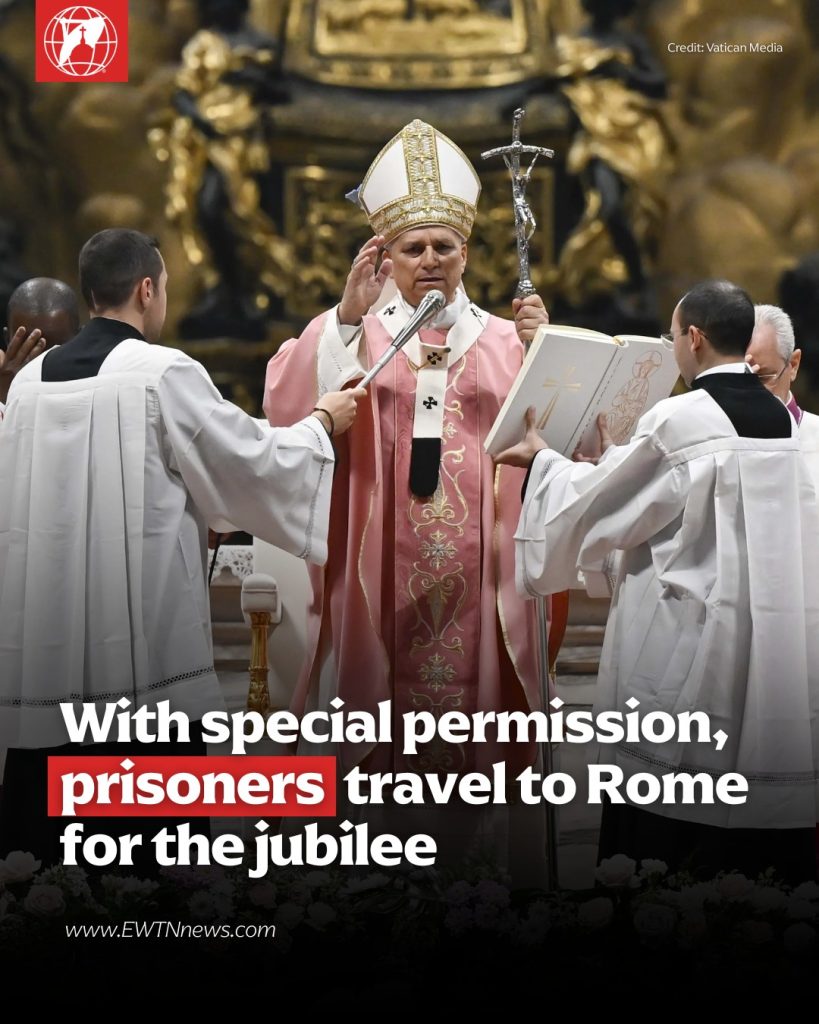
The host used for this Mass was produced by prisoners through the “Meaning of Bread” project run by the Fondazione Casa dello Spirito e delle Arti. Since 2016, the initiative has involved inmates in making communion hosts for more than 15,000 dioceses, religious communities, and parishes in Italy and abroad.
Overall, the Jubilee of Prisoners was marked by an unexpected sense of hope and joy, despite its engagement with difficult realities. Engaging deeply with Catholic expressions of faith, through pilgrimage, liturgy, symbolism and prayer, did not dilute my own Christian identity but strengthened it. This rich ecumenical encounter has also strengthened my own attentiveness to the breadth of the Body of Christ.
Find out about The Bill Snelson Young Ecumenists Fund and read about the experience of other grant awardees.
Main photo: Bernini’s Cathedra Petri. credit Melody Amadi